

Your A/C Is Breathing Through a Straw: Why a Dirty Outdoor Coil Costs You Money

Walk out to your outdoor unit right now and take a look at the sides of it. See that big finned surface behind the metal grill? That's your condenser coil, and right now it might be suffocating — packed with grass clippings, dirt, and a whole summer's worth of Gulf Coast gunk.
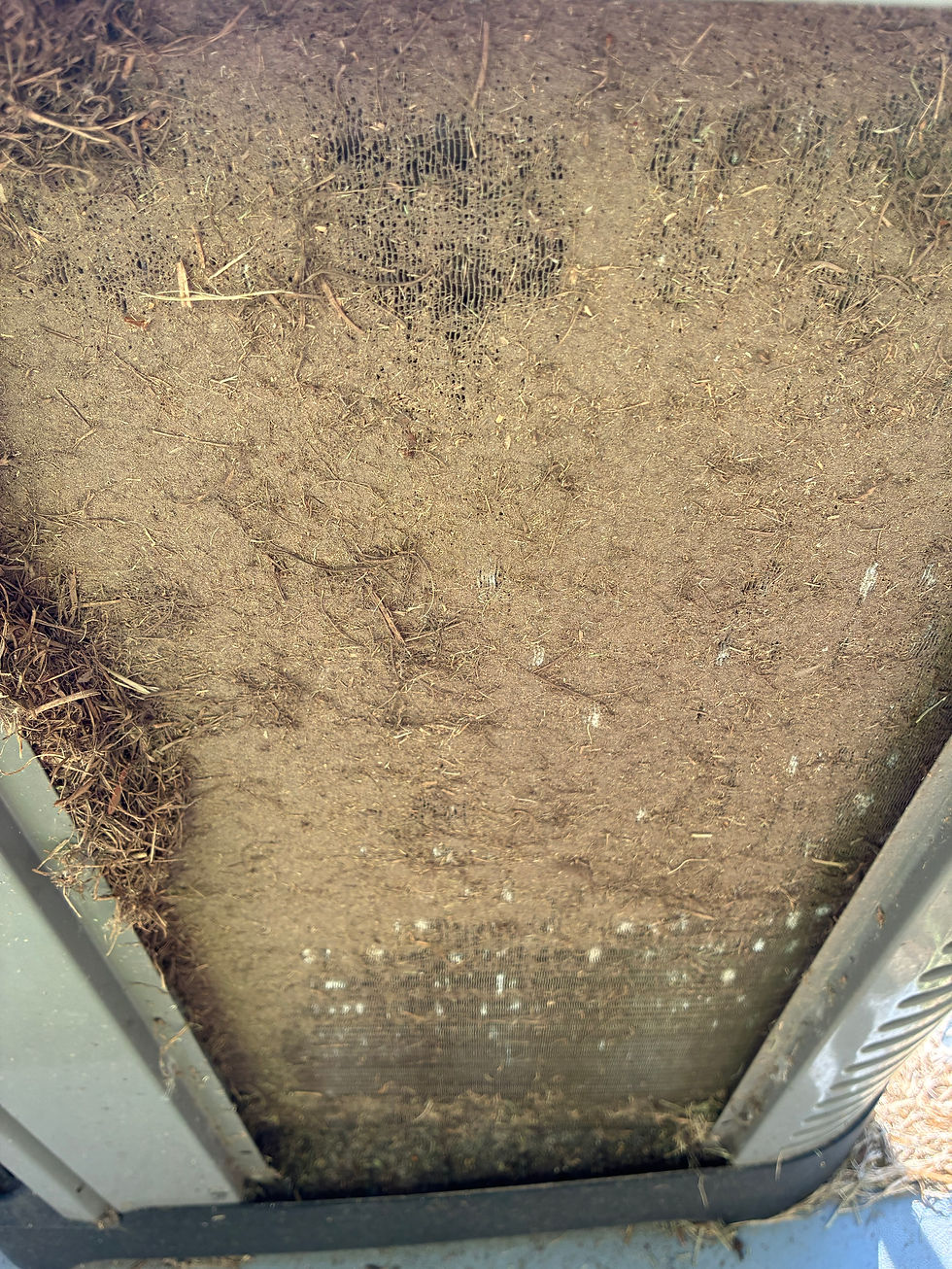
We know, because we see it every week. These photos are from a real service call: the coil was so matted with grass and debris that the unit could barely move air through it. That pile of dried grass in the first photo? That all came out of one outdoor unit. Imagine trying to cool your house while breathing through a pillow — that's what that system was doing.

What the outdoor coil actually does
Here's the simple version: your air conditioner doesn't make cold air out of nothing. It picks up heat from inside your house and dumps it outside through the condenser coil. Air has to flow freely through those fins to carry that heat away.
When the coil is clogged, the heat has nowhere to go. The system runs longer, works harder, and cools less. Your electric bill creeps up, your house stays a little warmer than the thermostat says, and the compressor — the most expensive part of the whole system — takes the beating. A dirty coil is one of the most common reasons we get "it's running but not cooling" calls here on the Coast.
How it gets this bad
It doesn't happen overnight. Every time you mow, the discharge side of the mower can blast grass clippings straight into the coil. Cottonwood fuzz, pine needles, leaves, and dirt build up between the fins. Around here, a season of regular mowing can pack a coil solid — especially if the grass is blowing toward the unit.

Signs your coil might be clogged
You don't need to take anything apart to spot the warning signs:
The unit runs longer cycles than it used to, or never seems to catch up on hot afternoons
Your power bill is higher than last summer without a change in your habits
Airflow coming out of the outdoor unit's fan feels weak
You can see grass, lint, or dirt matted between the fins
What you can do yourself — and what to leave to us
There are a couple of things every homeowner can safely do. Keep grass and plants trimmed back at least a couple of feet on all sides of the unit, and mow so the discharge blows away from it. You can also gently rinse loose grass off the outside with a garden hose — not a pressure washer, which can fold the fins flat and make things worse.
But a proper coil cleaning is a job for a technician. The real buildup hides deep between the fins where a hose can't reach, and the only way to clean it thoroughly is to open the unit up and wash the coil from the inside out with the right cleaner and technique. We've pulled coils from units that looked fine from the outside and were solid on the inside. That's why coil cleaning is part of every tune-up we do.
Fall is the perfect time for a checkup
Late September on the Gulf Coast is a natural checkpoint. Summer ran your system hard, and before the cooler months ask it to switch into heating mode, it's worth having a set of trained eyes on the whole thing — the coil, the refrigerant levels, the electrical connections, and the drain line. Catching a struggling compressor in September beats losing it on a 95-degree Saturday in July.
If your outdoor unit looks anything like these photos, or if your system has been working harder than usual, give us a call. We service all of Ocean Springs, Gautier, Biloxi, Pascagoula, Moss Point, Vancleave, and the surrounding Mississippi Gulf Coast. Reach us at (228) 990-4882 or stop by iveyheatandcool.com to schedule a tune-up — and get your system breathing easy again before fall settles in.
Family Owned, Gulf Coast Strong — We Fix It All!


Comments